Golden Hour Photography: The Complete Guide
Everything you need to know about shooting during golden hour — what it is, when it happens, how long it lasts, and how to get the best images.
Everything you need to know about shooting during golden hour — what it is, when it happens, how long it lasts, and how to get the best images.
What Golden Hour Actually Is
Golden hour is the stretch of time shortly after sunrise and shortly before sunset when the sun sits low on the horizon. At that angle, sunlight travels through a much thicker slice of the atmosphere than it does at midday. The atmosphere scatters short-wavelength blue light, leaving the longer-wavelength reds, oranges, and yellows to reach your lens. The result: warm, diffused, directional light with soft shadows and almost no harsh contrast.
The name is somewhat misleading. Golden hour doesn't always last 60 minutes. Depending on your latitude and the time of year, it can run anywhere from 20 minutes (Miami in June) to over 90 minutes (London in summer). Near the Arctic in midsummer, the sun skims the horizon for hours and golden light can persist well past what most people would call "one hour."
Use our golden hour calculator to find the exact window for your location and date before any shoot.
Why This Light Is Different
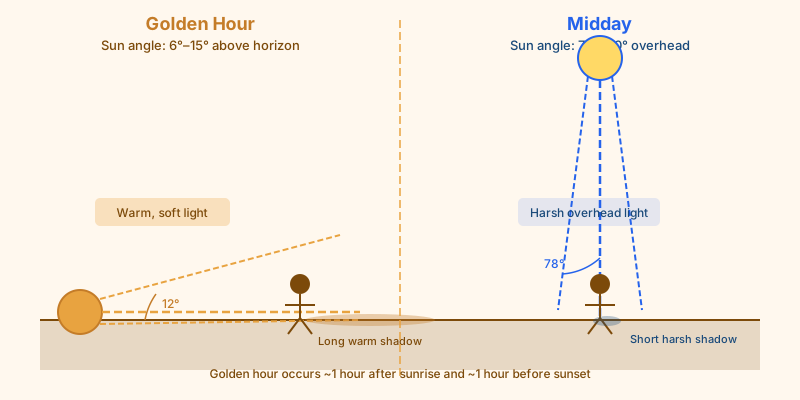
At midday, the sun is roughly 60–80° above the horizon at mid-latitudes. Shadows are short, harsh, and directly below subjects. Skin tones look washed out. Landscape details flatten. Even expensive lighting gear struggles to compete with the contrast ratio of direct overhead sunlight.
During golden hour, the sun is at 0–6° above the horizon. Shadows stretch long across the ground, revealing texture in everything from concrete to sand dunes. The low angle creates natural sidelighting that brings out dimension in faces, buildings, and terrain. And the warm color temperature — often around 3,000–4,000K, compared to 5,500K at noon — gives skin tones an inherently pleasing quality without any color grading.
This isn't a trick of post-processing. It's physics. You can't replicate it in Lightroom.
Morning Golden Hour vs Evening Golden Hour
Both windows produce the same basic type of light. But there are meaningful differences that should influence which one you schedule for.
Morning golden hour tends to have cleaner air with less atmospheric haze — most particulates and humidity settle overnight. Mist forms in valleys, over water, and along tree lines. Locations that were crowded at sunset the evening before are often empty at sunrise. The light is slightly cooler in tone at the very start, then warms quickly as the sun rises.
Evening golden hour runs a few minutes longer at most latitudes because of how the sun's angle interacts with the horizon. The air carries more atmospheric haze from the day's activity, which scatters additional warm light and adds intensity to reds and oranges. Clouds that have built up during the afternoon can create dramatic skies. And practically speaking: you can survey the scene during the day and arrive knowing exactly where to stand.
Most professional portrait photographers prefer evening. Most landscape photographers have a slight preference for morning, particularly when fog or mist adds atmosphere.
How Long Golden Hour Lasts
Here's what varies most: duration. Understanding it helps you plan realistic shoots.
At the equator (roughly 0° latitude), the sun rises and sets almost vertically. Golden hour is short — around 20–25 minutes year-round. In Miami (25°N), it's typically 30–40 minutes. In New York (40°N), expect 45–65 minutes depending on season. In Seattle (47°N) and London (51°N), summer golden hour stretches to 80–100 minutes.
Winter is interesting. At 47°N in December, the sun barely reaches 20° elevation at noon. The low solar path means the entire afternoon has a golden quality. Golden hour technically lasts longer, but the light is also dimmer and more diffuse.
The best way to know exactly what to expect on a specific date is to calculate your golden hour window in advance — not guess from memory or a generic sunrise table.
Shooting Locations: What Works Best
Not every subject benefits equally from golden hour light. Here's how different genres interact with it:
Portrait photography. Golden hour is flattering for virtually any skin tone. The warm color temperature enriches all complexions. Shoot with the sun behind and to the side of your subject for rim lighting, or face them toward the sun for a glowing warmth. Avoid shooting directly into the sun if your subject squints easily.
Landscape photography. The combination of long shadows and warm light reveals texture in terrain that disappears completely at midday. Rocky landscapes, rolling hills, and sand dunes all transform. West-facing scenes (cliffs, hillsides, mountain faces) receive the most light from an evening golden hour sun.
Architecture. Building facades pick up warm tones, windows reflect the sky, and shadow details in stonework or brickwork show up clearly. City streets look cinematic rather than documentary.
Wildlife photography. Animals are more active at dawn and dusk — which naturally aligns with golden hour windows. You get better behavior and better light simultaneously.
Planning Your Session
Know the window before you leave the house. Use the calculator for your city and shoot date, note the golden hour start and end times, then add buffer. Arrive 20–30 minutes before the window opens.
Scout locations beforehand when possible. Walk the spot at midday to understand how the light will move. A west-facing wall that's in shadow at noon will be lit directly at sunset. Know where the sun will be relative to your subject.
Set up quickly. The prime window — when the light is richest — often lasts only 10–15 minutes within the broader golden hour period. The first and last few minutes are when color and warmth peak. Have your composition decided before the window opens.
Read about camera settings for golden hour to make sure your exposure keeps up with rapidly changing light during this window.
After Golden Hour: Don't Pack Up
The 20–30 minutes after sunset (or before sunrise) is blue hour — civil twilight, when the sky turns deep blue and artificial lights balance naturally with ambient sky tone. Cityscape, architectural, and urban photographers often consider this the premium window for their genre.
If you've set up for a golden hour session, staying through blue hour costs you nothing but time. The gear's already out, the compositions are done. Just adjust your exposure as the light drops (increase ISO or slow your shutter) and keep shooting.
The full golden-to-blue sequence — arriving during civil twilight before sunrise or staying through civil twilight after sunset — gives you the widest variety of light in a single session. Our complete guide to blue hour photography covers exactly how to handle the transition.
The One Thing Most Beginners Skip
Consistent golden hour shooting requires consistent planning. The single biggest mistake beginners make is assuming they'll "catch the light when it looks good." That works occasionally, but it fails far more often than it succeeds.
Build the habit of checking golden hour times for any shoot you're planning. It takes 30 seconds with this calculator and eliminates the guesswork entirely. Over time, you'll develop an intuitive feel for how the light moves in your area — but the tool removes the need to wait for that intuition to develop.