Blue Hour Photography: The Light Most Photographers Miss
Blue hour — the 20–30 minutes of twilight after sunset and before sunrise — produces some of the most striking images in photography. Here's how to shoot it well.
Blue hour — the 20–30 minutes of twilight after sunset and before sunrise — produces some of the most striking images in photography. Here's how to shoot it well.
What Blue Hour Is (And Why Most Photographers Leave Too Early)
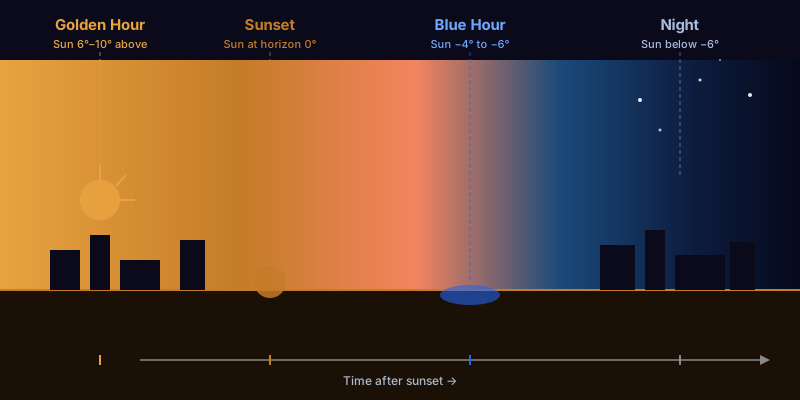
Blue hour occurs when the sun is between 0° and 6° below the horizon — the period astronomers call civil twilight. After sunset, there's a short window before the sky goes fully dark where ambient light from the sky is still strong enough to illuminate a scene, but it's deep, saturated blue rather than daylight white or golden orange.
The blue is real and physics-based. When the sun is below the horizon, short-wavelength blue light from the sky's upper atmosphere reaches your position, while the longer-wavelength warm light from direct sun no longer does. The result is a cool, even, deeply blue ambient light unlike anything you can get at any other time of day.
Most photographers pack up at sunset. They get their golden hour shots, watch the sun dip below the horizon, and figure the session is over. The photographers who stay for another 20–30 minutes often get the best images of the day.
Calculate your blue hour window for your city and date before shooting. The tool shows you the evening blue hour end time so you know exactly how much time you have after sunset.
Why Blue Hour Is Ideal for Certain Subjects
Not all subjects benefit equally from blue hour. The subjects that do are ones where artificial lights are a key part of the scene.
Cityscapes and skylines. This is where blue hour earns its reputation. At midday, city lights are invisible against a bright sky. At night, they're bright points on a black background. During blue hour, the sky is bright enough to show color, texture, and gradient while being dark enough that artificial lights are clearly visible and well-exposed. The exposure values align perfectly.
Architecture. Office buildings with lit windows, illuminated bridges, train stations, airports — all photograph best during blue hour because interior and exterior lighting balances with sky tone in a way that doesn't happen at any other time.
Roads and traffic. Long exposures during blue hour produce smooth light trails from car headlights and tail lights against a deep blue sky. The color contrast — warm orange/red trails against cool blue sky — is one of the most recognizable looks in urban photography.
Water reflections. Still water during blue hour becomes a mirror for the blue sky and city lights simultaneously. Rivers, harbors, and lakes reflect the scene with less glare than during golden hour.
How Long You Have
Blue hour duration varies with latitude. Near the equator, the sun drops steeply and civil twilight lasts only 20–25 minutes. At 47°N (Seattle), expect 30–40 minutes. At 51°N (London), it can stretch to 40–50 minutes.
Within that window, the "peak blue" moment — when the sky is richest in saturation and the balance with artificial lights is perfect — lasts roughly 5–15 minutes. The rest of the window is still useful, but the sky gradually darkens toward full night.
Know your window in advance. Use the calculator, note the evening blue hour start and end times, and plan to be at your location before the end of golden hour so you're ready when blue hour begins.
Camera Settings for Blue Hour
The challenge with blue hour is managing exposure as the light drops rapidly. Here's what to adjust:
Tripod. Not optional. Blue hour exposures run from about 1/15s at the start to 5–30 seconds toward the end. Handheld shooting at these speeds produces blur. Set up your tripod during golden hour so you're ready.
Aperture. f/8–f/11 for landscapes and cityscapes. You want sharpness throughout the frame, and the slower shutter speed compensates for the small aperture.
Shutter speed. Start around 1/15–1/30s at the beginning of blue hour and work down to multi-second exposures as darkness deepens. Use a remote shutter release to avoid camera shake.
ISO. Start at ISO 400–800. By the end of blue hour, you may need ISO 1600 to keep exposures manageable. Modern cameras at ISO 1600 produce clean results for cityscape work.
White balance. Set to Daylight (5,500K) or slightly cooler (4,000K) to preserve the blue tone rather than neutralizing it. Auto white balance will try to make the scene look more neutral, which removes the blue hour character.
The Blue-to-Golden Sequence: Shooting Both
Here's the approach that maximizes both windows in a single session:
Arrive at your location 30–45 minutes before sunset. Set up your composition during the remaining daylight. As golden hour begins, shoot your warm-light images. When the sun sets, don't move — adjust your exposure settings and shoot through blue hour.
The transition between the two windows is itself worth capturing. The 5–10 minutes immediately after sunset often produces a gradient sky that blends warm oranges at the horizon with deep blue overhead. This is sometimes called the "pink hour" or "afterglow" and it's brief, so be ready.
After you've shot the blue hour sequence, review your images while still on location. Blue hour is a short window — if you notice a compositional problem or a key element that was out of frame, you may have time to make one more attempt.
Composition Notes for Blue Hour
A few compositional principles that work especially well during blue hour:
Include light sources. Street lamps, illuminated windows, neon signs — these are your second light source during blue hour, complementing the sky. Frame compositions that include these elements intentionally.
Use reflections. Water, glass building facades, and wet streets all multiply the visual interest during blue hour. Rain actually improves blue hour cityscapes because wet pavement reflects both the sky and artificial lights.
Look for leading lines. Roads, rivers, railroad tracks, and bridges create depth. Long exposures during blue hour smooth out traffic on these lines, emphasizing the geometric structure.
Shoot wider than you think. The blue sky itself is the subject. A wide-angle lens that shows more of the sky often works better than a telephoto that frames a tighter subject.
For portrait work during blue hour, bring a speedlight or LED panel to illuminate your subject. The blue ambient light alone is too dim for portraits. But a warmed artificial key light against a blue sky background creates a striking contrast — artificially warm subject on a naturally cool background.
Read more about the science behind natural light timing to understand how blue hour fits into the full daily light cycle.