Landscape vs Portrait: Different Goals for the Same Golden Light
Golden hour means different things depending on what you're shooting. Here's how landscape and portrait photographers approach the same window with completely different techniques.
Golden hour means different things depending on what you're shooting. Here's how landscape and portrait photographers approach the same window with completely different techniques.
Same Light, Different Goals
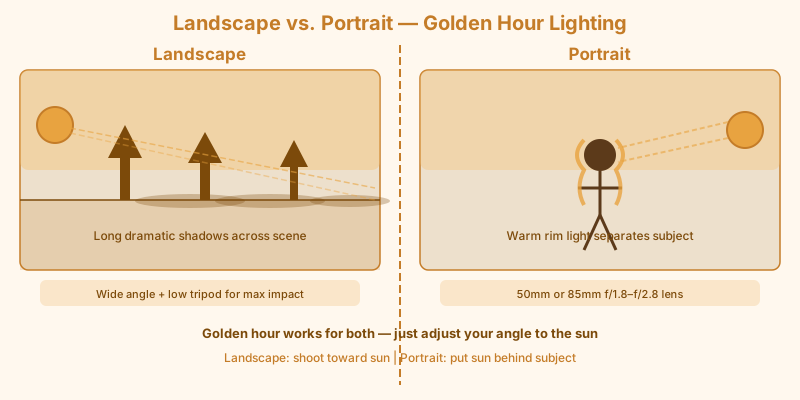
A landscape photographer and a portrait photographer standing side by side during golden hour are working in the same light but optimizing for entirely different things. The landscape photographer wants sidelight to reveal terrain texture, a small aperture for front-to-back sharpness, and a composition that uses the sky and foreground together. The portrait photographer wants backlighting to create rim light, a wide aperture for background blur, and a position that puts the subject's face in open shade.
Understanding this divergence — and which approach you're taking on any given shoot — prevents the confusion that comes from applying landscape habits to portrait situations and vice versa. Calculate the golden hour timing for your location to confirm you're working with the right window for both.
What Landscape Photographers Want From Golden Hour
For landscape photography, golden hour delivers three specific things that matter most:
Texture. Low-angle sidelight grazes across terrain surfaces — grass, rock, sand, soil, water — at an angle that emphasizes every bump, furrow, and ripple. The same field that looks uniformly green at midday reveals individual grass blades, dew, and soil texture when lit from 5° above the horizon. This is why landscape photographers care more about the sun being low than the sun being warm.
Color. The warm, reddish light changes the color of everything in the scene. Granite mountains turn orange. Green vegetation picks up golden highlights. Sand dunes glow amber. The color shift applies to every surface simultaneously, creating a visual coherence that midday light doesn't produce.
Long shadows. Shadows extending hundreds of feet across a landscape create depth and dimension. Mountain shadows, tree shadows, cloud shadows on rolling hills — all of these only happen when the sun is low. They're one of the primary compositional tools of landscape photography.
The technical approach for landscape work: wide or ultra-wide lens (14–35mm), f/8–f/11 for depth of field, tripod, ISO 100–400, graduated neutral density filter to balance bright sky against darker ground, and bracketed exposures for HDR blending.
What Portrait Photographers Want From Golden Hour
Portrait photographers care about different qualities in golden hour light:
Color temperature as flattery. The warm 3,000–4,000K color temperature of golden hour light flatters human skin tones across a wide range of complexions. Cool light (5,500K+) emphasizes shadows and blue undertones. Warm light minimizes them and produces richness.
Soft directional fill. Even when shooting backlit (with the sun behind the subject), the warm ambient light from the sky provides soft, directional fill on the face. This combination — rim light from behind, soft fill from in front — creates three-dimensional depth without harsh shadows.
Controllable background. An out-of-focus warm background during golden hour acts as a visual context element that no other lighting situation can produce. The bokeh (background blur) takes on the color of the ambient light and produces the soft, glowing aesthetic that defines the golden hour portrait look.
The technical approach: fast prime lens (50mm f/1.8 to 85mm f/1.4), wide aperture (f/1.8–f/2.8), metering on the subject's face, +0.7 to +1 stop exposure compensation for backlit subjects, and a reflector or small flash for fill.
The Compositional Difference
Landscape compositions during golden hour work with scale. Wide frames, strong foregrounds, dramatic skies, and depth from front to back. The subject — the landscape itself — doesn't move. You have time to set up a tripod, wait for the light to hit a specific angle, and bracket exposures.
Portrait compositions work with intimacy and separation. A narrow frame with shallow depth of field separates a single subject from the scene. The subject is a person who moves, blinks, and reacts. Speed and responsiveness matter more than precise setup.
This compositional difference often means the two approaches require different locations, even within the same golden hour window. A landscape photographer wants unobstructed views, strong foreground elements, and directional vistas. A portrait photographer wants open sky, clean backgrounds, and shade for the subject's face. These aren't usually the same spot.
When the Two Approaches Overlap
Some subjects benefit from elements of both approaches. Environmental portraits — images where the landscape and person are both important — balance the wide-angle texture work of landscape photography with the lighting concerns of portrait work.
For an environmental portrait during golden hour:
- Use a moderate wide angle (24–35mm rather than 14–20mm)
- Find a position where the subject is naturally lit from the side, not backlighting them
- Use f/4–f/5.6 rather than fully wide open — you want the person sharp and the background identifiable, not fully blurred
- Shoot at the transition between golden hour and blue hour when both sky and subject are equally exposed
Travel portraits, adventure photography, and outdoor lifestyle work all fall into this category. The technique blends both approaches.
Timing Your Genre
For pure landscape work, the most critical minutes are in the 10–15 minutes around sunrise and sunset themselves — when the sun is between 0° and 3° above the horizon and shadows are longest. Arrive before the window opens to be fully set up.
For portrait work, the window is slightly more forgiving. The best light is in the 20–30 minutes before sunset (when the sun is between 3° and 8° above the horizon) because the light is warm but not as harsh as it is just above the horizon. Use the golden hour calculator to identify this sub-window within the broader golden hour for your location.
For cityscapes and architecture, the target is after sunset — blue hour — when artificial lights balance with ambient sky tone. This is distinct from both golden hour approaches but runs immediately after the portrait window closes.
Read more about how to prepare the right gear for golden hour work based on which genre you're focusing on.