Golden Hour Photography Gear: What to Bring and Why
A practical gear checklist for golden hour shoots — from essential equipment to optional accessories, with reasons for each item based on how the light actually behaves.
A practical gear checklist for golden hour shoots — from essential equipment to optional accessories, with reasons for each item based on how the light actually behaves.
Why Golden Hour Needs a Specific Gear Approach
Golden hour photography presents two technical challenges that most other types of photography don't: rapidly changing exposure and a short, non-repeatable window. The light drops by 1–2 stops over the course of the session, and once the window closes, you can't go back for more.
Good preparation means arriving with the right gear already set up, not figuring out what you need while the light is changing around you. Calculate your golden hour window for your location and date before building your gear list — the session length and conditions should inform what you bring.
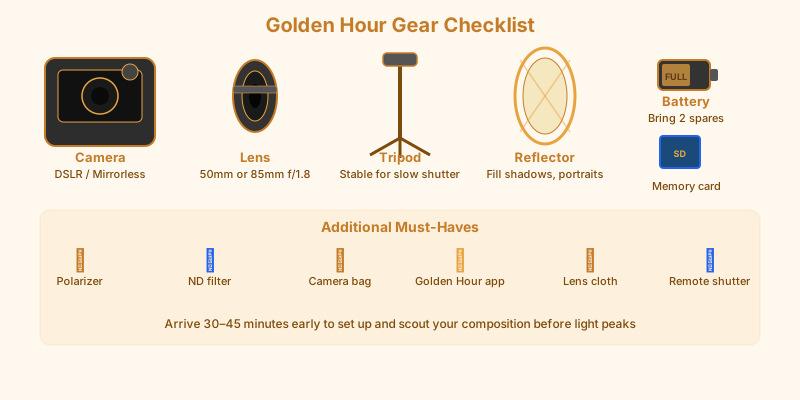
Essential: The Non-Negotiables
Camera body. Any interchangeable lens camera works. For golden hour, the primary consideration is low-light performance in the last 15 minutes of the session. Full-frame sensors outperform crop sensors at ISO 1600+, but modern APS-C cameras (Sony a6xxx series, Fuji X-T series, Nikon Z30) produce clean results at ISO 1600 for standard output sizes.
Fast prime lens. A fast prime at f/1.8 or f/2.0 is more useful during golden hour than a zoom for most applications. A 50mm f/1.8 ($150–200) on full-frame or a 35mm f/1.8 on APS-C are the most versatile starting points. The wide aperture lets you maintain shutter speed as the light drops and produces the background blur that defines the golden hour portrait look.
Extra batteries. Cold morning air reduces battery capacity significantly. Even in mild weather, a session that starts in ambient light and runs into dusk drains batteries faster than normal shooting because you're chimping (reviewing images on the LCD) more often in difficult light. Bring at least one extra charged battery per body.
Memory cards with adequate capacity. You'll shoot more frames during a golden hour session than during a similar-length midday session because each minute of light is different and you're trying to capture variations. 32GB minimum; 64GB recommended if you shoot RAW. Bring more than you think you need.
High Value: Should Bring for Most Sessions
Tripod. For landscape, architecture, and blue hour work, a tripod is nearly mandatory by the end of the session. Even for portraits, a tripod stabilizes your composition so you can focus on the subject rather than framing adjustments. A carbon fiber travel tripod (Joby GorillaPod or Peak Design Travel Tripod) adds minimal weight for significant stability benefit.
Reflector (5-in-1, 43 inches). A medium-sized reflector gives you fill light for backlit portraits without the complexity of flash equipment. The silver side provides neutral fill; the gold side adds warm fill that matches golden hour ambient. An assistant holds the reflector in front and slightly above the subject's face to fill shadows. Without one, backlit portraits often have underexposed faces.
Lens hood. Essential for backlit shooting (which is much of golden hour portrait work). The lens hood blocks off-axis light from the sun and prevents the contrast-reducing flare that happens when sun hits the front element directly. If your lens didn't come with a hood, third-party options cost $10–20.
Polarizing filter. For landscape and outdoor photography, a circular polarizer reduces glare on water, increases sky contrast, and removes reflections from foliage. Most useful during the early-to-middle portion of the golden hour window. Polarizers cut 1.5–2 stops of light, which becomes noticeable at the end of the window — remove it when the light gets dim.
Situation-Specific: Bring When Relevant
Graduated ND filter. For landscape photography at golden hour, the sky is often 3–5 stops brighter than the foreground. A graduated neutral density filter (2-stop hard grad or 3-stop soft grad) reduces the sky exposure without affecting the foreground, allowing a single properly exposed frame rather than HDR blending. The Lee 100mm system or similar 100mm square filter systems offer the most flexibility.
Small LED panel or speedlight. For late golden hour and blue hour portraits, some artificial fill light preserves subject detail when ambient drops too low for purely natural-light work. A small Godox V1 speedlight or Aputure AL-MX LED panel adds minimal bulk and gives you the option of mixed-light shooting as the session transitions to dusk.
Remote shutter release. For tripod work, any camera movement during a long exposure creates blur. A wired remote ($15) or wireless remote ($30) eliminates the vibration from pressing the shutter button. Essential for blue hour multi-second exposures; very useful for golden hour landscape work on a tripod.
Knee or hip pad. Golden hour landscape photography involves a lot of low-angle work. Wet grass, cold concrete, and gravel are uncomfortable without padding. A thin foam pad weighs almost nothing and makes low-angle shooting sustainable across a full session.
What to Leave Behind
Heavy zoom telephoto lenses. Unless you're specifically shooting wildlife or sports during golden hour, a 70–200mm f/2.8 adds significant weight for limited benefit. The compression effect is useful, but a 85mm or 135mm prime achieves similar compression at half the weight. Leave the heavy zoom for dedicated telephoto sessions.
Drone (unless permitted and practiced). Golden hour drone footage is spectacular, but operating a drone requires attention that takes you away from ground-level photography. If you're bringing a drone, plan a drone-only session rather than trying to do both simultaneously.
Heavy laptop. Some photographers bring a laptop for tethered shooting and on-site editing. Unless you're on a commercial shoot that requires it, the laptop adds weight with minimal benefit during the golden hour window itself. Review on the camera LCD and edit at home.
The Setup Sequence
Arrive 20–30 minutes before the golden hour start time. (Calculate your window to know when to leave home.) Use the arrival time to:
1. Set up tripod and frame your primary composition
2. Test exposure and check histogram
3. Set white balance (Daylight, 5,500K — not auto)
4. Attach lens hood
5. Check battery level and memory card space
6. Identify backup compositions if primary doesn't work
When the window opens, you're shooting rather than setting up. The gear preparation happens before the light arrives.