8 Golden Hour Photography Mistakes (and How to Fix Each One)
The most common reasons golden hour shoots fail — arriving late, wrong white balance, over-relying on auto mode, and six more — with specific fixes for each.
The most common reasons golden hour shoots fail — arriving late, wrong white balance, over-relying on auto mode, and six more — with specific fixes for each.
Why Golden Hour Shoots Disappoint
Most photographers have had at least one experience of arriving at a location for golden hour and coming away with images that don't match the light they saw. The light was beautiful; the images aren't. This usually comes down to predictable, fixable mistakes.
Before your next session, calculate your exact golden hour timing and use the list below to set up your workflow so none of these issues apply.
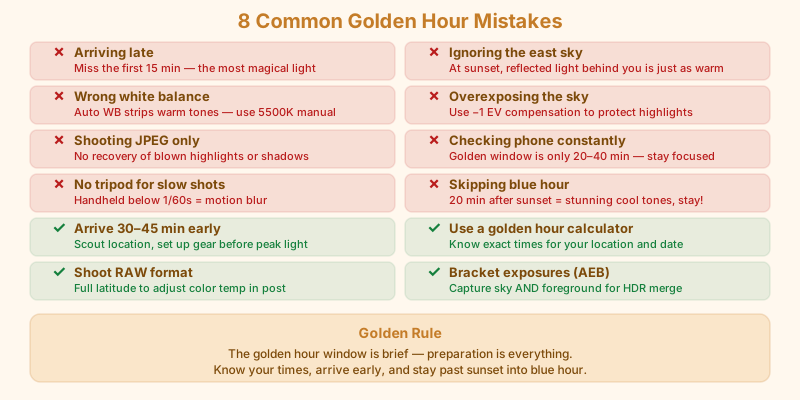
Mistake 1: Arriving When Golden Hour Starts
If you arrive at the location when golden hour begins, you've already lost 10–15 minutes of setup time. By the time you're in position with your composition set and your settings dialed, you're well into the window.
The fix: Arrive at least 20–30 minutes before the golden hour start time. Use the pre-golden light (civil twilight, when the sky is bright but the sun is still below the horizon) to set up your composition, test your exposure, and identify where the light will fall when it arrives.
The 5–10 minutes just after golden hour begins are often the best of the session. Don't miss them because you were still parking the car.
Mistake 2: Auto White Balance
Auto white balance (AWB) removes the golden tones from your images. The camera's sensor is programmed to neutralize color casts — and the warm amber light of golden hour is, from the camera's perspective, a color cast to be corrected.
The result: images that look technically correct but lose the warmth that makes golden hour special.
The fix: Set white balance manually to Daylight (5,500K) or Cloudy (6,500K). These presets preserve the warm tones rather than removing them. If you shoot RAW, you have the option to adjust white balance in post — but shooting with a warm preset means you're evaluating your images accurately on the LCD during the session, which helps you make exposure decisions in the moment.
Mistake 3: Underexposing Backlit Shots
Backlit photography — with the sun behind your subject — is one of the defining golden hour portrait looks. The problem: in-camera meters read the bright background and underexpose the subject's face.
You get a properly exposed sky and a dark, silhouetted subject. Sometimes that's intentional; usually it's not.
The fix: Apply +0.7 to +1.3 stops of exposure compensation for backlit subjects. Check the histogram after the first frame: you want the subject data in the middle of the histogram, even if it means the background is somewhat overexposed. Use spot metering on the subject's face if your camera supports it.
If you're metering off a gray card held at the subject's position, the reading is already correct for the subject — no compensation needed.
Mistake 4: Shooting With Auto ISO and No Minimum Shutter
Auto ISO is useful but dangerous during golden hour when light levels change rapidly. Without a minimum shutter speed set, the camera may allow the shutter to slow to 1/15s or slower to keep ISO down — producing motion blur from any subject movement or camera shake.
The fix: If using Auto ISO, set a minimum shutter speed. On most cameras, this is in the ISO Auto menu. Set the minimum to 1/200s for any subject that might move; 1/100s for static subjects with image stabilization.
Alternatively, set exposure manually and adjust it consciously every 5–10 minutes as the light drops. Manual control produces more consistent results through the window than letting the camera make exposure decisions in changing light.
Mistake 5: Shooting Only in the First or Last Minutes
Many photographers concentrate their best efforts in the first minutes (just after golden hour starts) or the very last minutes (just before sunset). The assumption: those are the most dramatic. They're often not.
The very beginning of golden hour can still have contrast that's too strong, especially in summer when the sun is still several degrees above the horizon. The very end is sometimes rushed and chaotic.
The fix: Plan to shoot throughout the window, but front-load your most technically demanding compositions into the middle 20–30 minutes when the light is warmest, softest, and most consistent. Save simple, quick compositions (silhouettes, close portraits) for the final minutes when managing complex setups is harder.
Mistake 6: Not Scouting the Location
Arriving at a location for the first time during golden hour means spending part of your window orienting yourself — finding angles, walking the space, discovering where the light falls.
The fix: Scout any new location during midday on a day before your shoot. Walk the space in full light and notice: which surfaces face west (for evening), which areas have open sky, where shade structures are for portrait fill, where the horizon is visible. Make a note of exactly where you'll stand and what direction you'll face.
When you return during golden hour, you already know the space. You're shooting, not exploring.
Mistake 7: Giving Up Before Blue Hour
Golden hour ends, the sun drops below the horizon, and many photographers pack up and leave. They've missed the second window of the session.
Blue hour — the 20–30 minutes of civil twilight after sunset — produces different and complementary light to golden hour. For cityscapes, architecture, and long-exposure work, it's often better than golden hour itself.
The fix: Stay at your location through the transition. Adjust your settings for the drop in ambient light (slower shutter, higher ISO, tripod if not already deployed) and keep shooting. The transition between golden hour and blue hour — the 5–10 minutes just after sunset — sometimes produces the most dramatic skies of the entire session.
The golden hour calculator shows both the evening golden hour end and the blue hour end times — plan your session to use both windows.
Mistake 8: Focusing on Perfect Conditions and Missing Good Ones
Overcast forecast? Partly cloudy? Some photographers cancel golden hour sessions when conditions aren't ideal. They wait for the perfect clear sky at sunset, which sometimes never arrives for weeks.
Partially overcast conditions often produce better golden hour photography than perfectly clear skies. Thin high clouds diffuse the light softly. Broken cloud cover creates dramatic, variable light. Even an overcast day can break along the western horizon 15 minutes before sunset and produce an unexpected burst of intense color.
The fix: Lower the threshold for going. If there's any clearing in the forecast, go. If there's a partial overcast, go. Learn to recognize the conditions that produce interesting light rather than waiting for conditions that simply produce a lot of light.
Read how weather affects golden hour light to understand what different cloud and atmospheric conditions produce, so you can make better go/no-go decisions.
---
Golden hour photography rewards preparation more than any other type of shooting. Know your window. Arrive early. Set your camera up before the light arrives. These habits eliminate most of the problems on this list before they can occur. Start by calculating your next golden hour window and building your session plan around it.