Magic Hour in Film Photography: Shooting Analog During Golden Light
Film and magic hour are a natural match — but analog photography's fixed ISO and limited exposures demand a more deliberate approach than digital. Here's how to make it work.
Film and magic hour are a natural match — but analog photography's fixed ISO and limited exposures demand a more deliberate approach than digital. Here's how to make it work.
Why Film and Magic Hour Go Together
The look that photographers associate with golden hour photography — warm tones, lifted shadows, a particular luminosity that feels almost painted — is partly what film photography produces naturally. The halation (light bleeding around bright highlights) that slide film and color negative film produces around specular highlights and bright edges is most visible during magic hour, when the sun is close to the horizon and highlight sources are abundant.
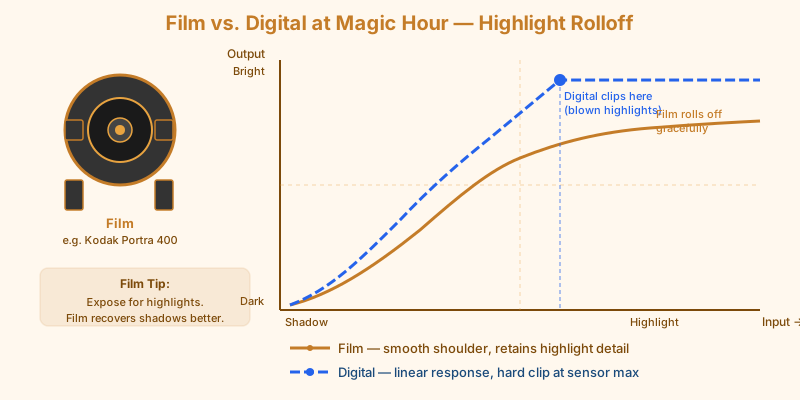
Film's grain structure, its characteristic color response curves, and the way it handles highlight rolloff all align with what magic hour light produces. Shooting magic hour on film doesn't require any manipulation to get "the look" — the look is built into both the medium and the light simultaneously.
The challenge is practical: film has a fixed ISO that you set when loading the roll. As magic hour light drops by 2–3 stops over the session, your exposure options narrow significantly without changing shutter speed or aperture. And you have 36 frames — not 1,800 — to work with.
Calculate your exact magic hour window before loading a roll. On a 24- or 36-exposure roll, you want to know precisely how much time you have and plan your frames accordingly.
Film Stock Selection for Magic Hour
The film you choose matters more during magic hour than at any other time, because different stocks respond differently to low-light, warm-toned scenes.
Kodak Portra 400. The standard recommendation for a reason. Portra 400's latitude (ability to retain detail across a wide exposure range) is excellent — you can rate it at box speed or push it to 800 without dramatic quality loss. Its skin tones are warm and natural, and it handles golden hour light with rich but not oversaturated results. For portrait work during magic hour, Portra 400 is the go-to.
Kodak Portra 160. More saturated shadow detail and slightly finer grain than 400 at the cost of two stops of speed. If you're shooting the start of golden hour in good light and plan to wrap up before the window ends, 160 gives you improved resolution and color depth. Not ideal if you're shooting through to blue hour.
Kodak Ektar 100. Higher saturation and very fine grain. The highly saturated response intensifies warm tones during golden hour — reds and oranges go deep. Excellent for landscape and nature work where saturation is an asset. Less flattering for portraits because of how it renders skin tones.
Fujifilm Pro 400H. Cooler, less warm response than Portra. Useful when you want to moderate the orange/amber quality of golden hour without fully losing it. Produces a more natural, less "filtered" look. Discontinued but available on secondary markets; Fuji Superia 400 is a more accessible alternative with a similar cool-neutral character.
Fujifilm Provia 100F (slide film). For dramatic, high-contrast golden hour landscape work, slide film's narrow latitude and high saturation produce results unlike any negative film. Expose carefully (meter the highlights and accept shadow underexposure) and the results can be extraordinary. Zero room for error on exposure — one stop over means blown highlights on slide film.
Metering for Film at Magic Hour
Accurate metering is more important on film than digital because you can't check a histogram between shots. Every frame is a committed exposure.
Use a separate handheld meter. The Sekonic L-308 or L-398 are affordable, accurate, and give you incident metering (measuring light falling on the subject rather than reflected from it). Incident metering is significantly more reliable for magic hour work than reflective metering, because bright backgrounds don't fool it into underexposing the subject.
Expose for shadows. Negative film (Portra, Ektar, Superia) handles highlight overexposure better than shadow underexposure. The general film metering rule is "expose for the shadows, let the highlights fall." During magic hour, this often means exposing 1 stop more than the meter indicates for backlit or open-shade subjects.
Recheck exposure every 10 minutes. As the light drops, your meter reading changes. A roll loaded with an f/2.8, 1/250s, ISO 400 starting exposure may need f/2.8, 1/60s or f/2.0, 1/125s by the end of the session. Recheck and adjust.
Frame Allocation
36 frames across a 60–90 minute magic hour session. That's roughly 1–2 frames every 2–3 minutes if you shoot throughout. In practice, the distribution should look like this:
- First 15 minutes (setting up, first light): 4–6 test/warmup frames
- Middle window (prime golden light): 18–24 frames on your key compositions
- Final 10–15 minutes (deepening color, transition to blue hour): 6–8 frames
Don't overshoot the beginning trying to capture every stage of development. The light in the middle 20–30 minutes of the golden hour window is almost always the best. Save frames for it.
Technical Challenges: What Goes Wrong
Motion blur in the last 15 minutes. As the light drops, shutter speeds slow. At ISO 400 on Portra, f/2.0, 1/30s becomes the floor for handholding. Below that, camera shake is likely. A tripod solves this for static subjects. For portraits or moving subjects, accept that the last portion of the session may produce less sharp images — or bring a faster film (push Portra 400 to ISO 800 by deliberately overexposing by 1 stop and having the lab push process).
Meter reading errors from bright backgrounds. Backlit magic hour scenes have extremely bright backgrounds behind darker subjects. In-camera reflective meters read the bright background and underexpose the subject. Handheld incident meters or a spot meter reading from the subject's face avoid this.
Lab instructions. If you push film for the darker portions of the session, communicate this to your lab. Mark the roll "Push 1 stop" or "Push 2 stops" as needed. Don't mix pushed and normally exposed rolls in the same bag without labeling.
The Unique Advantage of Film at Magic Hour
Beyond the look, there's a workflow advantage to shooting film during magic hour: the constraint of 36 frames forces discipline. On digital, it's easy to machine-gun frames through the entire window and edit 600 images afterward. On film, you think before you shoot.
This constraint — which feels like a limitation — produces more intentional compositions, better subject timing, and more considered use of the brief window. Many photographers who shoot both digital and film find that their magic hour film sessions produce a higher percentage of keeper images not because film is technically better, but because the process slows them down.
Track your magic hour windows across the shooting seasons and plan your film sessions for the dates and locations where the light will be most favorable for the stocks you're working with.